
Penticton has a local rule that can change the due-diligence checklist for a particular kind of real-estate deal: buying, selling or redeveloping a purpose-built rental building or long-term-stay motel with five or more units.
Council adopted Tenant Protection Bylaw No. 2026-12 on March 17, 2026. The City says it applies when a covered rental property is proposed for demolition or partial demolition. It does not apply to houses, buildings with four or fewer units, ordinary building renovations or a landlord ending a tenancy for a reason unrelated to redevelopment.[1][2]
That boundary is the useful “wow, I didn’t know that” fact. Five units can move a property into a different local redevelopment process. It does not automatically make the property unsuitable, freeze a sale or prevent new housing. It means the buyer, seller and advisers should identify tenant obligations and redevelopment timing before treating the site like vacant land.
Count the lawful rental units before counting the redevelopment upside.
LOCAL SCOPE
The rule is about redevelopment, not every rental sale
A tenanted property can be sold without ending the tenancies. B.C.’s current guidance says the buyer becomes the new landlord and existing tenancies continue on the same terms unless a proper legal process ends them.[4] Penticton’s bylaw does not turn every apartment-building sale into a demolition case.
The local trigger is narrower. The City describes covered properties as purpose-built rental buildings and motels with five or more units when demolition or partial demolition is proposed. A detached house with a suite, a duplex, a four-unit building and a renovation that does not involve demolition are outside the scope described on the City’s project page.[1]
That distinction matters in marketing and negotiations. “Five rental units,” “five legal dwelling units,” “five rooms” and “five occupancies” may not describe the same thing. The actual approvals, plans, licences, tenancy records and lawful use need to be checked. A buyer should not rely on an advertisement’s unit count when the count determines whether an additional municipal process may apply.
The bylaw also should not be confused with the provincial rules for a purchaser who plans to occupy one rental unit. B.C. has separate notice requirements for purchaser or landlord occupancy. The Penticton rule discussed here is specifically about displacement connected to covered redevelopment.[1][3]
APPROVAL PATH
A relocation plan comes before redevelopment approval
For a covered project, the City says the developer must submit a Tenant Relocation Plan before redevelopment approvals are granted. That plan must address notice timing, relocation support and financial compensation.[1]
This is a practical acquisition issue. A redevelopment concept can look workable on a land-use map while still carrying a people-and-timing obligation that affects the project schedule, cash requirements and communications. Tenant information should therefore enter the feasibility review early, not after design work and financing assumptions are fixed.
A careful buyer will want a current rent roll, all tenancy agreements and amendments, deposit records, notices already given, payment history, unit status and any arrangements that may not appear in the standard documents. The buyer’s lawyer should confirm which obligations transfer on closing and how deposits, prepaid rent, notices and representations are handled in the contract.
A seller should prepare the same record set before marketing. Incomplete tenancy files can slow buyer review, create inconsistent statements and make it harder to distinguish a straightforward income-property sale from a purchase that depends on vacant possession or redevelopment. Neither party should promise that tenants will leave by a target date unless the promise is supported by the applicable law and actual approvals.
PROJECT COST
Three months’ rent is not a stand-alone project budget
The City summarizes its minimum local requirement as financial compensation of at least three months’ rent plus a moving allowance.[1] That figure is important, but it is not a complete redevelopment budget and should not be multiplied casually from an unverified unit count.
First, actual rents differ by unit and tenancy. Second, provincial guidance describes municipal tenant-protection tools as potentially including financial assistance, moving assistance and help finding replacement housing; that overview is not a project-cost calculator.[5] Confirm how the local and provincial requirements interact for the specific property rather than simply adding headline figures. Third, a relocation plan can involve administration, communication, a coordinator and assistance finding replacement housing in addition to the headline payment.
Provincial guidance separately says a demolition or conversion notice generally requires four months’ notice after all necessary permits and approvals are in place, and that the tenant should receive compensation equal to one month’s rent. A tenant receiving that notice has 30 days to dispute it.[3][4] Those are provincial rules; they do not replace the Penticton relocation-plan gate.
The safe feasibility approach is to build a tenant-by-tenant worksheet reviewed by the appropriate legal and planning professionals. Include the verified monthly rent, tenancy type, statutory dates, local-plan requirements, expected administration and a timing contingency. Do not use one round “per door” allowance as if it proves compliance.
WORK SCOPE
Demolition and renovation are different paths
The City says its local bylaw does not apply to building renovations.[1] That does not mean a renovation is automatically simple or that a landlord may empty a building merely by calling the work a renovation.
Under B.C.’s provincial process, a landlord seeking possession for major renovations or repairs must show that the work is necessary, that vacancy is the only reasonable way to complete it, that required permits and approvals are in place and that the Residential Tenancy Branch has granted an order of possession. The Province also describes a right of first refusal for tenants displaced by qualifying renovation work in residential properties containing five or more rental units.[3]
Demolition is different because the rental unit ceases to exist. Provincial guidance permits a four-month demolition or conversion notice only after all legally required permits and approvals are obtained and the landlord intends in good faith to carry out the stated purpose.[3]
For buyers and sellers, the lesson is not to choose a label first. Start with the actual scope of work. Does the proposal remove units permanently, partially demolish a building, require vacant possession for major repairs, convert the use or leave tenancies in place while work proceeds? The answer directs the team toward different approvals, notices and risk controls.
PENTICTON CONTEXT
Why the rule matters in Penticton now
Penticton adopted the bylaw after the Province gave municipalities authority to create tenant-protection bylaws. The provincial framework allows added financial assistance, moving assistance, help finding replacement housing and, where a local bylaw requires it, opportunities to enter another tenancy agreement.[5]
The local context is a rental market that has improved but remains constrained. The City reported a 2.6% Penticton vacancy rate for October 2025, up from 1.2% a year earlier. It also reported average rent of $1,387 and median rent of $1,324 in that annual CMHC snapshot.[6] Those are historical market-wide measures, not today’s available-unit count and not the rent for any particular replacement home.
The City’s project page says five covered rental properties had been demolished in the previous nine years. Two were intended to be replaced with rental buildings, two were redeveloped with strata units and one became a commercial building.[1] That history explains why the rule is targeted rather than a requirement on every residential transaction.
The bylaw does not prove that redevelopment is bad, that all old rentals should remain unchanged or that every future project will displace tenants permanently. It recognizes that adding housing and protecting residents during a transition are separate project questions. A proposal can increase the eventual unit count while still requiring a workable plan for people living there now.
AUDIENCE GUIDE
What this means for you
DUE DILIGENCE
A seven-step property check
- Confirm the lawful unit count. Compare the listing, assessment, licences, permits, plans and tenancy records. Do not assume bedrooms or motel rooms equal lawful rental units.
- Identify the actual project. Separate continued operation, renovation, partial demolition, full demolition, conversion and new construction.
- Read every tenancy document. Verify rent, deposits, fixed terms, amendments, notices and informal arrangements that require clarification.
- Meet the City before relying on timing. Confirm whether the property and proposed work fall within the Tenant Protection Bylaw and which development approvals are needed.
- Map the provincial process. Confirm required permits, notice form, compensation, dispute period and good-faith obligations with qualified advice.[3][4]
- Model relocation costs and time. Use tenant-specific facts and include administration and contingency rather than one unverified allowance.
- Write the contract around evidence. Use appropriate subjects, document-delivery requirements, representations and closing adjustments. A real-estate contract should not promise a legal outcome the seller cannot deliver.
RICO’S VIEW
Rico’s view: count the units before counting the upside
Small income properties are often discussed in simple real-estate language: price per door, current cap rate, future density and land value. Penticton’s bylaw adds a necessary question before that shorthand becomes a decision: how many lawful rental units exist, and does the buyer’s plan involve demolition?
For a building with four or fewer units, this particular local rule is not the process described by the City. At five or more covered units, a relocation plan becomes part of the redevelopment path.[1] That one-unit difference can change due diligence even when two sites look similar from the street.
The answer is not to avoid rental property. It is to value the property that actually exists, with its current tenants, lawful use and real approval path. A well-prepared seller can reduce uncertainty. A disciplined buyer can avoid paying for a vacant-land timeline that is not supported. Tenants can understand that a sale and a redevelopment notice are not the same event.
Use the guided Matchmaker to organize a Penticton property search. If you are planning to sell an income property, visit Sell, or contact Rico for a property-specific real-estate discussion.
This article provides general real-estate information, not legal, tenancy, planning, tax, appraisal, financing or investment advice. Rules and facts can change. Buyers, sellers, landlords and tenants should confirm the current requirements with the City of Penticton, the Residential Tenancy Branch and their own qualified advisers.
Sources
- City of Penticton — Tenant Protection Bylaw
- City of Penticton — March 17 Council Highlights
- Province of B.C. — types of evictions
- Province of B.C. — selling a rental property
- Province of B.C. — new local-government housing tools
- City of Penticton — rental housing availability snapshot
- Wikimedia Commons — Penticton Morning Walk 10
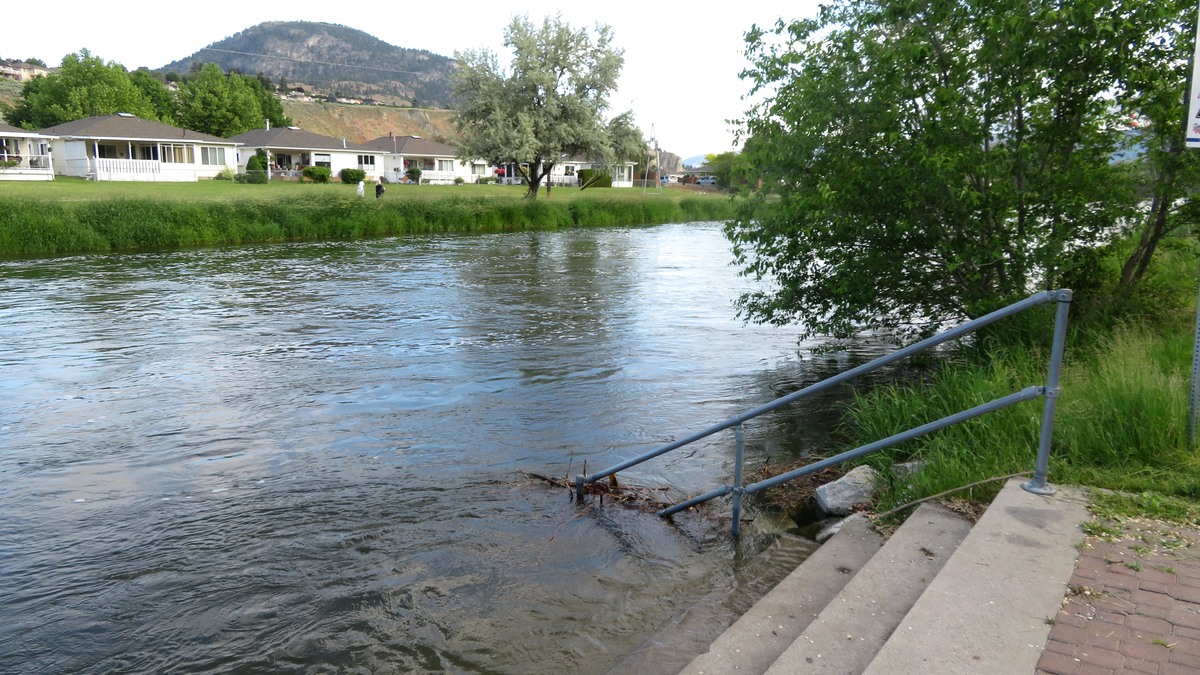
Image credit: Blake Handley, Wikimedia Commons, CC BY 2.0. Representative homes beside Penticton Creek; not a redevelopment site, rental listing or affected property. Cropped and lightly contrast-adjusted.
Turn the information into your next step
Choose the path that matches the decision you are making now.
Planning a Penticton move? Explore Rico’s Penticton real estate guidance and current listings.